Cut
Rotate a blade fast enough to efficiently cut vegetation.
 Start a conversation
One integrated platform
DESIGNED FROM FIRST PRINCIPLES
Engines became motors. Batteries replaced fuel. Sensors enabled autonomy. Yet the basic cutting architecture remained largely familiar.
Orbit Mower started with a basic question: What does a mower actually need to do?Rotate a blade fast enough to efficiently cut vegetation.
Move that cutting action across the surface that needs to be mowed.
Instead of adapting a traditional mower to electric and autonomous operation, Orbit Mower was designed around these two requirements from the ground up.
THE ORBIT PRINCIPLE
Four independently powered cutting assemblies arranged around a low central chassis. Final engineering implementation may differ.
Conventional mower blades rotate to create the cutting action while the deck carries them across the lawn. Orbit Mower introduces a second coordinated motion: individual blades rotate to cut while the cutting assemblies travel around the mower's central axis.
Independent blade rotation creates the cutting action.
Cutting assemblies travel around the central axis.
Independent units create opportunities to respond to terrain and cutting loads.
MECHANICAL ANALOGY
A drone works to prevent unwanted rotation. Orbit Mower explores how rotational and blade-generated aerodynamic forces can become useful within the cutting system. This is a mechanical analogy—not a claim that the mower operates like an aircraft.
TERRAIN RESPONSE
Orbit Mower is designed around a low center of mass, wide footprint, independent cutting assemblies, and strategic placement of heavy components—principles intended to improve stability and create more freedom to respond to changing contours and loads.
STAGED CUTTING TEST
Electric motors become less efficient as cutting load rises and the motor begins to bog. Orbit Mower's adaptable architecture creates an opportunity to remove vegetation progressively rather than force the full cut at once.
In testing with a conventional 56V electric mower, staged cutting averaged 0.447 Ah versus 0.693 Ah for a single fixed-height cut. Reported statistical significance: p = 0.001. This tested the staged-cutting principle—not a production Orbit Mower—and does not guarantee equivalent real-world Orbit savings.
ARCHITECTURE COMPARISON
The comparison focuses on system architecture and design objectives.
Primarily fixed cutting arrangement
Independent cutting assemblies with orbital movement
Primarily blade rotation
Blade rotation + orbital cutting-unit movement
Cutting plane largely dictated by chassis and deck
Designed for independently responsive cutting assemblies
Battery powers cutting and vehicle movement
Explores staged cutting and useful interaction between rotational and aerodynamic forces
Automate the mower
Rethink the mower, then automate it
Comparison describes architectural differences and design objectives. Actual performance varies by mower model, terrain, vegetation, operating conditions, and final Orbit Mower implementation.
PLATFORM OBJECTIVES
Designed to reduce unnecessary cutting load and make better use of rotational motion.
A low, wide platform and adaptable cutting architecture designed around challenging ground.
Independent cutting units create opportunities for staged and responsive vegetation management.
A mechanical platform designed specifically for autonomous mowing requirements.
Orbit Mower is developing a mowing platform designed around the physics of the cutting task and the requirements of autonomous operation.
PROPRIETARY MOWER TECHNOLOGY
Orbit Mower is developing a fundamentally different approach to rotary mowing. Rather than relying solely on a conventional fixed cutting arrangement, Orbit Mower combines independently rotating cutting blades with cutting assemblies capable of traveling around the mower's central axis.
This creates two forms of rotational movement: the rotation of the individual cutting blades and the orbital movement of the cutting assemblies themselves.
Orbit Mower's technology is supported by an international intellectual-property portfolio spanning multiple generations of the system, including granted patents and additional patent-pending technology.
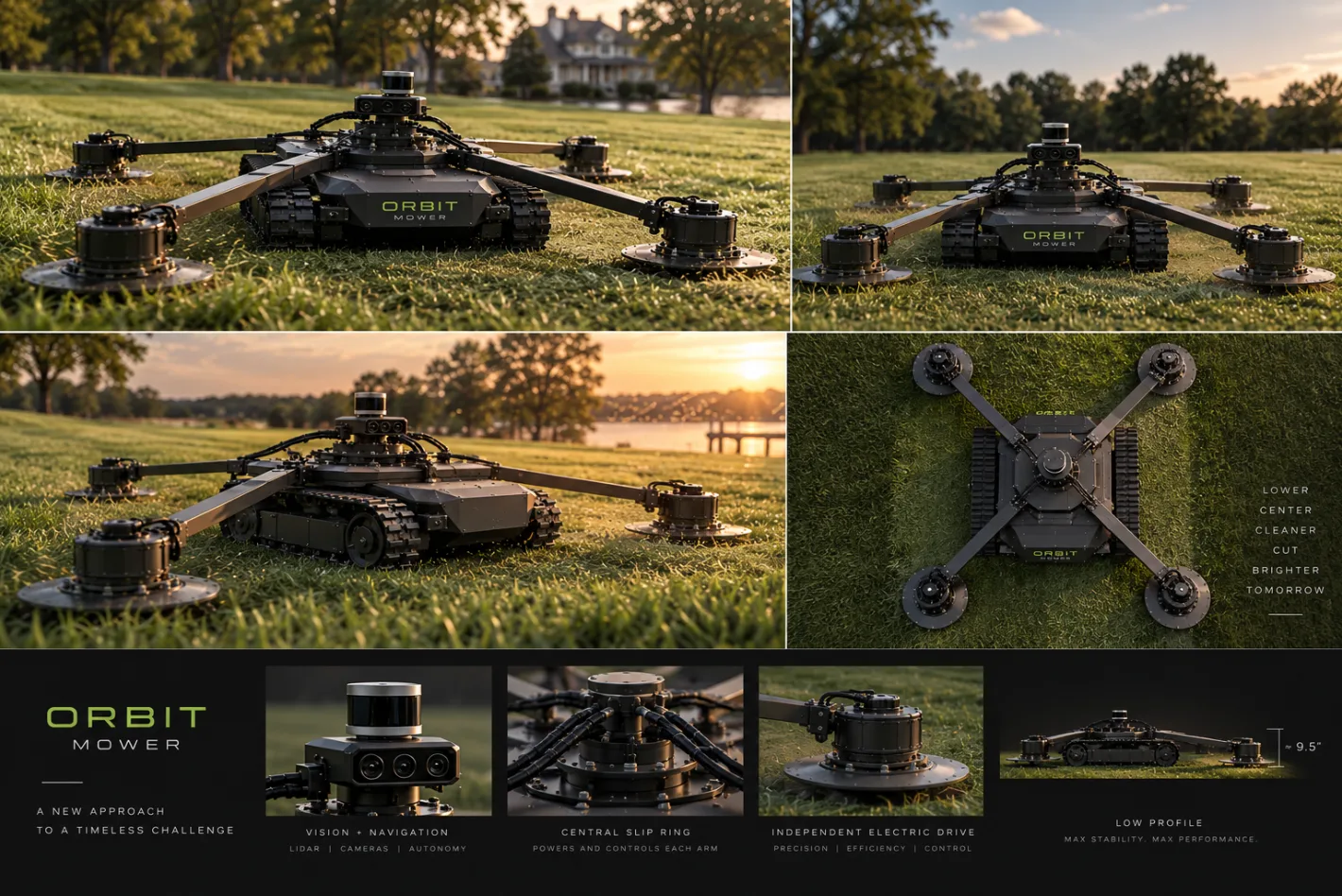
A visual study of the low-profile chassis, four-arm arrangement, independent electric cutting units, and central power-transfer architecture.
Each cutting blade rotates around its individual motor shaft to cut vegetation.
Cutting assemblies are mounted to arms connected to a central rotating structure, allowing the cutting units themselves to orbit around the mower.
Additional Orbit Mower technology explores controlled movement of individual cutting assemblies using aerodynamic forces, spring-supported components, and other proprietary mechanisms.
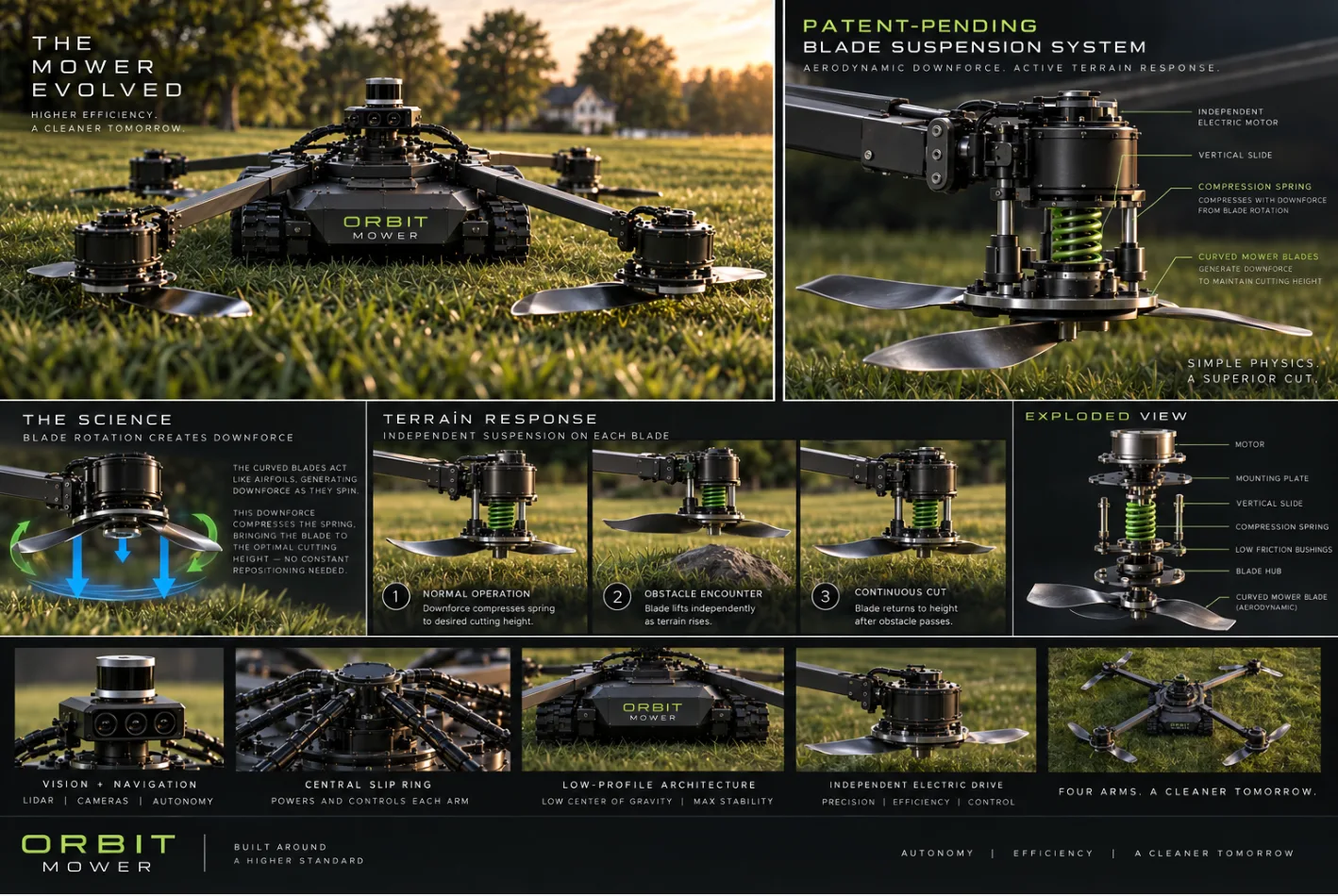
This visualization communicates the system principles described below. It is conceptual and does not disclose unreleased engineering details or define patent claim scope.
THE ORBIT IP PORTFOLIO
FOUNDATIONAL SYSTEM
This patent family covers foundational aspects of Orbit Mower's vegetation-cutting architecture, including a rotating turret or structure, cutting tools connected through arms, orbital movement of cutting assemblies around the mower, and related mechanical and electrical systems.
This architecture allows the cutting assemblies to travel around the mower while the individual blades simultaneously rotate to cut vegetation.
NEXT-GENERATION SYSTEM
This newer patent family builds upon the Orbit Mower architecture and covers additional approaches involving thrust-generating cutting blades, vertical and/or orbital movement of cutting assemblies, spring-supported blade and motor assemblies, and systems for controlling this movement.
In simple terms, Orbit Mower is exploring how aerodynamic forces generated by a rotating blade can become a functional part of the cutting system rather than simply a byproduct of blade rotation.
Dennis Matthew Kave
Tyler Matthew Kave
Lauren Anne Kave
Orbit Mower continues to develop additional proprietary and patent-pending technologies designed to improve cutting-unit movement, responsiveness, load management, and overall mower performance.
Details of unreleased patent applications are intentionally not disclosed.Patent information is presented as a factual, plain-language overview of publicly documented technology and is not a statement of claim scope or legal advice.
THE BUSINESS MODEL
Refine the prototype, communicate the physics, and validate the value of the protected design.
Engage manufacturers, investors, and category experts who can help move the architecture toward market.
License the patented technology to established manufacturers with the production, distribution, and service networks to scale it.
“Our goal is bigger than manufacturing one mower. We want to create a cutting platform that established brands can bring to customers at scale.”
THE ORBIT MOWER TEAM
Orbit Mower brings together original engineering insight and focused commercialization work.

PRESIDENT • CO-INVENTOR
Tyler leads Orbit Mower’s business development, brand, and licensing strategy. A business-focused entrepreneur at the University of North Carolina at Chapel Hill, he works to make the mower’s engineering understandable and turn the family’s protected technology into valuable industry partnerships.
FOUNDER • CO-INVENTOR
Dennis originated and developed the core Orbit Mower concept. He leads the invention’s technical direction, connecting the rotating architecture, power-transfer system, staged cutting process, and impact-responsive blades into one integrated mowing platform.
LET’S MOVE THE IDEA FORWARD
We’re building relationships with manufacturers, licensing partners, and people who see a new future for lawn care.
Start a conversation ↗